Wheelchair Simulator
Learning to drive an electric wheelchair takes practice, but real training needs space, supervision and a wheelchair that is not always free. This simulator lets people practise as often as they want, in VR on the Meta Quest 3 or on a desktop with keyboard and mouse.
- Context
- Built in partnership with the Braga Cerebral Palsy Association (APCB). My Master's final project, currently in its real-world application phase.
The problem
Driving an electric wheelchair takes motor coordination, spatial awareness, and fast reactions to obstacles. Those skills need repetition to build, but real-world training rarely allows for it: you need a large space, constant supervision, and a wheelchair that isn't always available. The barrier to practice isn't willingness, it's logistics.
What I built
A driving simulator that removes those constraints, letting users practise at their own pace as many times as they need. Ten progressive levels, each unlocking as you complete the one before, take you from the fundamentals (straight lines, 90° and 180° turns, an obstacle course, reverse driving, navigating a tight apartment) out into urban scenarios with moving pedestrians, ramps, traffic lights, and crossings. There's also a freestyle mode: an open virtual city with no timer or scoring, for consolidating skills without pressure.
Under that sits realistic wheelchair physics with real-world speeds and a choice of front- or rear-wheel steering, a collision system that distinguishes frontal and rear impacts from lateral slips, gamification with one to three stars per level, and per-patient performance tracking that records completion time and keeps a full session history rather than just the latest run, so therapists can follow progress across sessions. Fully localised in Portuguese and English.
Built in Unity and C#, running both as a fully immersive VR experience on the Meta Quest 3 and as a desktop version with keyboard and mouse. Developed in partnership with the Braga Cerebral Palsy Association, and published on the Meta Horizon Store.
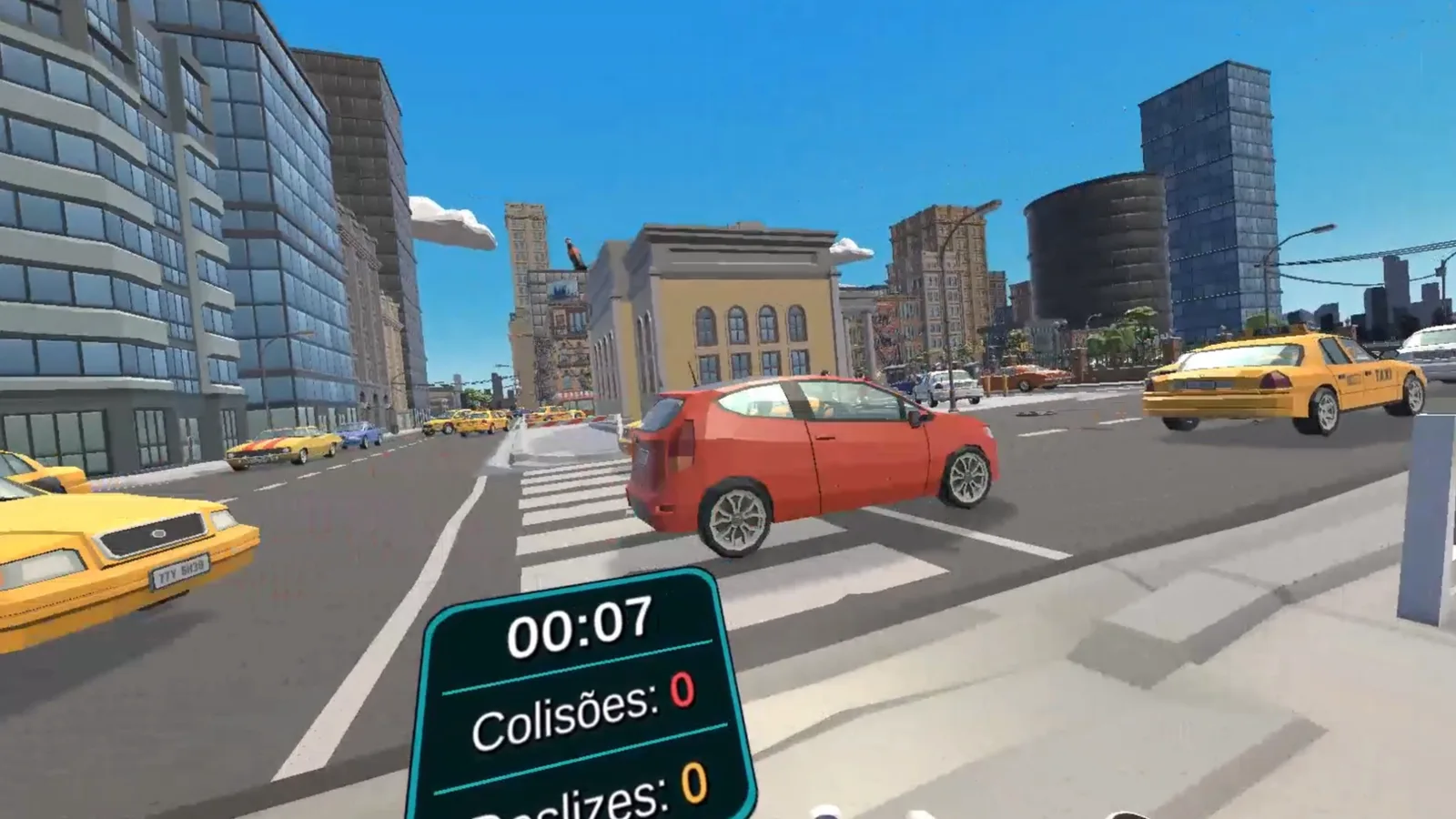
An urban level, where the traffic has to be read before crossing. The HUD tracks time, collisions and lateral slips. 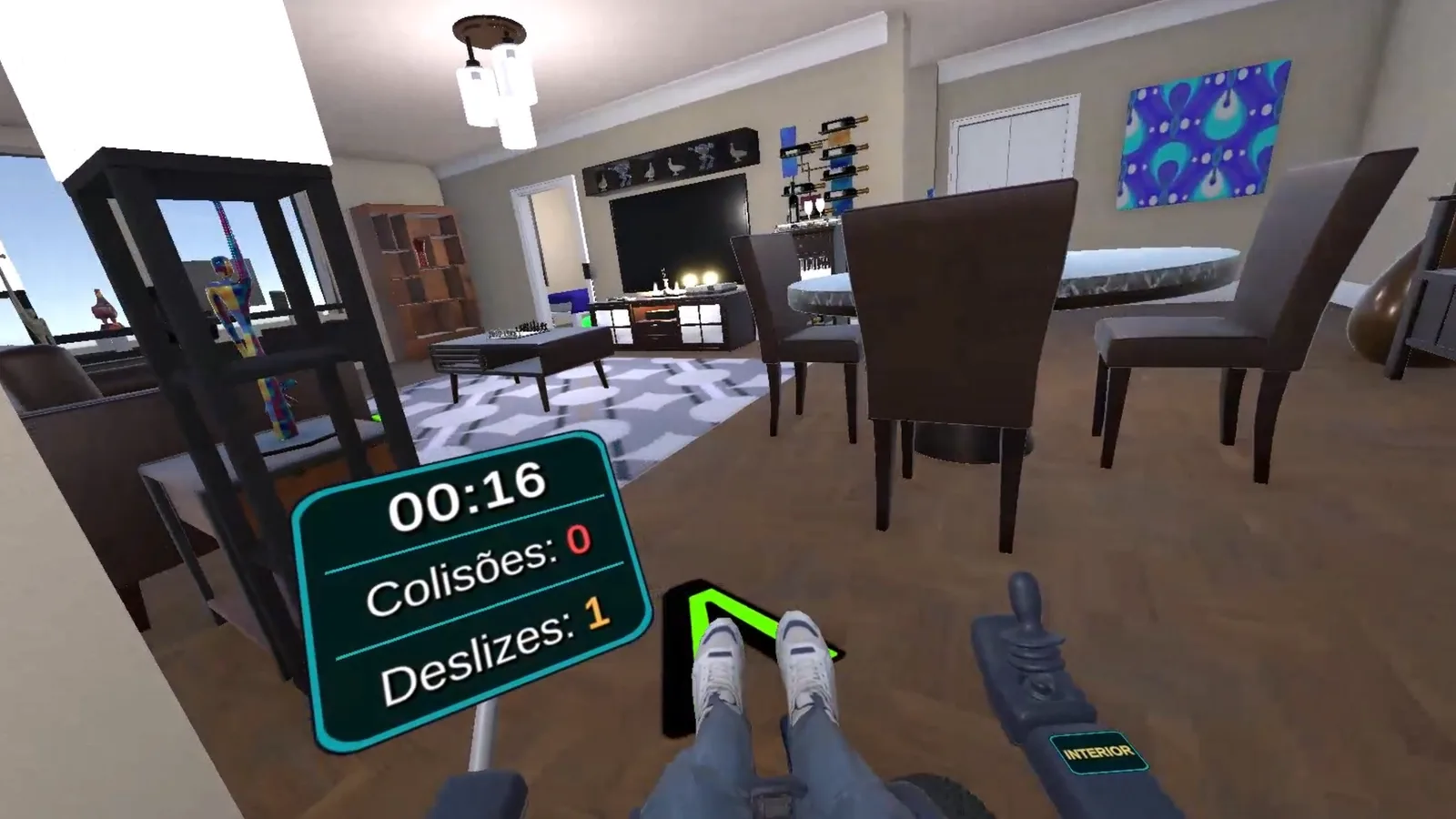
The apartment level, where the doorways and furniture leave very little room to turn.
Decisions & trade-offs
Two builds instead of one
The VR version is the real training experience, but not every clinic or user has a headset. The desktop build means anyone can practise, and it let people try the project without putting on a Quest.
Tracking per patient, not per session
What matters to a therapist is the trend, not one run. Frontal collisions, rear collisions and lateral slips are recorded separately instead of as a single score, so you can see what is improving, not just whether it is.
Frame rate as an accessibility constraint
On the Quest 3, a low or unstable frame rate causes motion sickness, and a training tool that makes people nauseous does not get used. That set the limit on how much could go into each scene.
What I learned
I learned Unity from scratch for this project, and the hard part was never the language, it was the domain: physics tuning, scene optimisation, and everything specific to building for VR rather than a screen.
Motion sickness was the constraint that taught me the most. In VR, keeping frame rates high on standalone hardware isn't an optimisation you do at the end, it's a design constraint you build around from the start, and it affects level scale, asset density, and how movement is handled. A desktop game that drops frames is annoying. A VR training tool that drops frames makes the user physically unwell and stops the training.
Working with the APCB also taught me that features I assumed were secondary (how forgiving the physics are, whether a failed run restarts immediately) mattered more to real users than the ones I'd been focused on.
Recognition
- Presented at CIPA 2026
- Presented at SASYR 2026
- Article published in the RIAGE journal
- Short paper at SASYR
Tech stack
- Unity
- C#
- Virtual Reality
- Meta Quest 3